
Contacts Addresses View
QuickEasy BOS allows users to create an address book of all their Staff, Customers, Suppliers, and other contacts. This address book is named Contacts.
There are two List Views which display a list of Contacts with key information. Edit View allows users to add or edit the information (if they have the required authority).
Contacts can be opened from other modules such as transactions. However, in those cases a popup form is opened that has limited functionality.
Navigation: Main Menu > Setup > Contacts > Menu (button) > Addresses
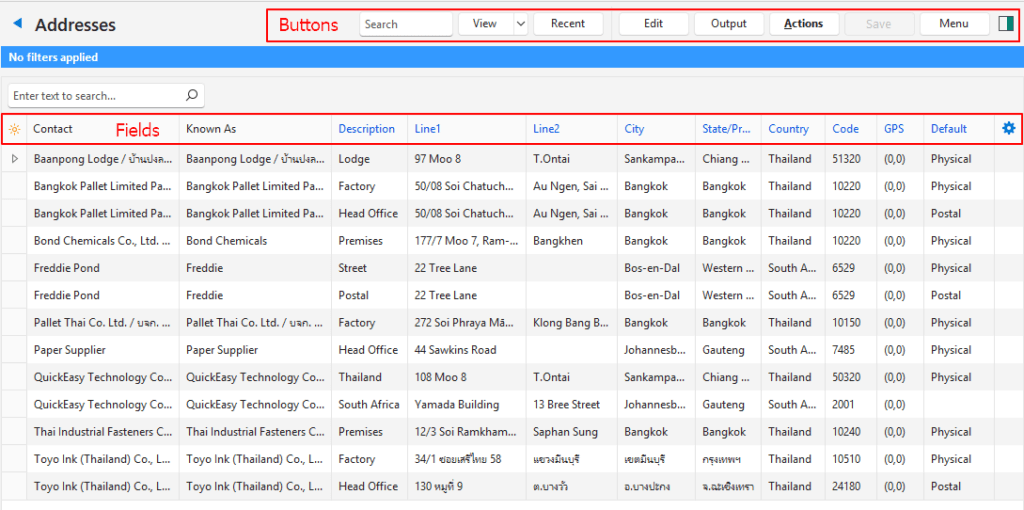
Buttons Explained
| Button | Description |
|---|---|
| View | Generates a list of entries as per the selected data filters. |
| Arrow on View Button | Reset Data Filter > Resets all the data filters. |
| Recent | A dropdown list of recently viewed records for quick access to those records. The button is supressed if there are no recent items. |
| Edit | Allows Users to edit the entry. |
| Output | Prints, previews, or exports the selected report if Output Templates are added. Allows the display to be exported in .xlsx, .csv, or .htm format. |
| Actions | Allows for changes to be made to multiple records that can be selected using Ctrl + Left Click. The options are: Batch Update: Updates the following fields to the information typed in or selected in the adjacent block, once Update (button) is clicked, and confirmed. – Description – Line1 – Line2 – City – State/Province – Country – Code – Default Format: Formats the description so each word starts with an uppercase letter, and the rest is in lowercase. |
| Save | Saves any changes. |
| Menu | Views – Default – Addresses Settings – User Access – Edit Statuses (Customer) – Edit Statuses (Supplier) – Edit Statuses (Asset) – Edit Attributes – Edit Accounting (Accounts, VAT Types, Currencies, Credit Terms, Bank Profiles) – Edit Billing Methods – Edit Categories – Edit Positions Layout |
Fields Explained
Fields marked in blue in QuickEasy BOS are editable.
| Field | Description |
|---|---|
| Field Chooser (*) | Allows users to add or remove columns. |
| ID | The system-generated number for the entry. |
| Contact | The name of the Contact which can be the full name of the person or the name of a business. |
| Known As | The person’s Nickname, or the organisation’s Trade Name. |
| Description | The address’s Description. |
| Line1 | The first line of the address (e.g. Unit Number and Building Name). |
| Line2 | The second line of the address (e.g. Street Name and Number). |
| City | The City in which the address is. |
| State/Province | The State or Province in which the address is. |
| Country | The Country in which the address is. |
| Code | The Postal or Zip Code for the address. |
| GPS | The address’s GPS coordinates. |
| Created | The date on which the entry was created. |
| Updated | The date on which the entry was updated. |
| Updated By | The User who last updated the entry. |
| Default | Whether the address is a default Postal or Physical address. |
| Widget | Left click the last column to display an X. Click the X to delete the entry (default addresses cannot be deleted). |
Learn More
- Contacts Default View: Explains the default display of a list of contacts.
- Contacts Edit View: Explains the interface from which contacts are created.
- Contacts Tutorials Creating and Editing: These tutorials explain how to create and edit contacts.
- Contacts Tutorials Viewing: These tutorials explain the different views and related functions that are available for contacts.
- Customer Records List and Edit Views: Explains the interface to view a list of customers and to create customer records.
- Customer Records Tutorials: These tutorials explain how to display customer lists and how to create, edit, and delete customer records.
- Supplier Records List and Edit Views: Explains the interfaces from which supplier records are displayed and created.
- Supplier Records Tutorials: These tutorials explain how to display supplier lists, and how to create and edit supplier records.
- Billing Methods: Explains the billing methods’ interface and how to create and edit billing methods.
- Contact Categories: Explains what groups are and how to use them.
- Credit Terms: Explains the interface for credit terms and provides tutorials on how to create them.
- Positions: These tutorials explain how to create, edit, and delete job positions.