
Setup Example – Supplier Payments
- Supplier Payments are used to record payments made to suppliers.
- The same Transaction Type can be used to pay suppliers in multiple currencies.
- If the selected bank account does not match the supplier’s currency, the payment is converted to the local currency. In this case, an additional bank entry may be needed to capture any forex gain or loss.
Header
- Description: Supplier Payments
- Code: SP
- Entities: All
Settings (tab)
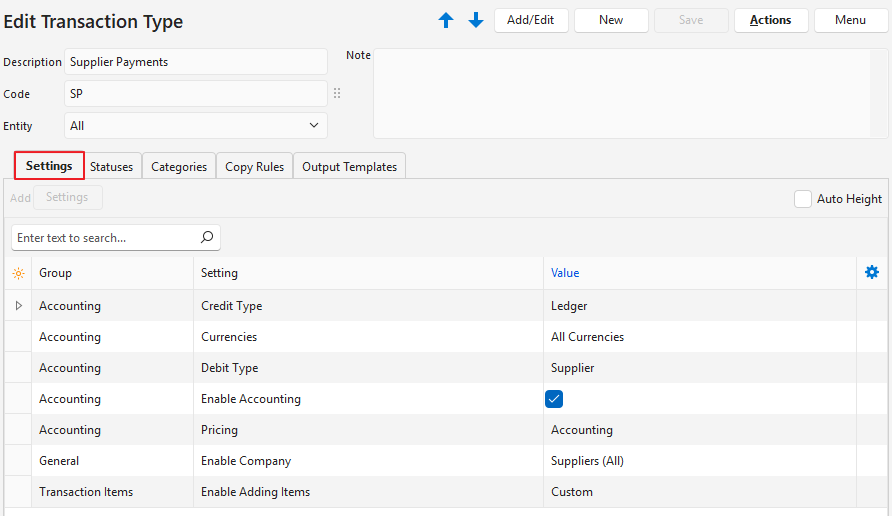
- This section lists the compulsory and optional settings that can be used to customise Supplier Payments.
- Settings with Default as part of the name, can be changed when capturing a transaction.
| Setting | Description | Value | When Required |
|---|---|---|---|
| Accounting > Currencies | Field to select which currencies apply to the transaction type. The options are: – Local: The transaction type can only use the local currency. – Company Currency: The transaction type can use the customer or supplier’s currencies. – All: The transaction type can use all the currencies set up for the organisation. | All | If you receive invoices or pay in foreign and local currencies. |
| Accounting > Default – Credit Account | A dropdown list of all the created Accounts for users to select a default account. | Select a bank account. | If you generally pay from a specific bank account. |
| Accounting > Credit Type | A dropdown list of Account Types for users to select one. The options are: – Customer – Supplier – Ledger | Bank | Always |
| Accounting > Debit Type | A dropdown list of Account Types for users to select one. The options are: – Customer – Supplier – Ledger | Supplier | Always |
| Accounting > Enable Accounting | A checkbox. If checked, accounting is enabled. If unchecked, transactions are created in the module and not posted to the Ledger. | Check the checkbox. | Always |
| Accounting > Pricing | A dropdown list to select a pricing option: – None – Cost Price – Sell Price – Supplier Price – Accounting | Accounting | Always |
| Defaults > Default – Data Filter | The default display when a list of transactions for the transaction type is viewed. The options are: – Today – This Month – Pending – Active – Pending & Active | Select an option from the dropdown list. | The default filter is: Pending & Active. Add the setting if you want a different default filter. |
| General > Enable Company | Users can select an access option as follows: – N/A – Customers (All) – Customers (Active) – Suppliers (All) – Suppliers (Active) | Suppliers (All) | Always |
| General > Reference Lookup | A field to type Reference lookup lists. | Click the Value column and enter the lookup fields, one entry per line. Check the Auto Height checkbox to display the lookup list in full. | If you want staff to select a reference from a lookup list instead of typing one. |
| Transaction Items > Enable Adding Items | Allows users to specify which type of items can be added to a transaction. The options are: – None: No items are added, only the header information is displayed. This option should be used sparingly and not for accounting transactions because there will be no fields for amounts. – All: Users may add items and custom items. – Custom: Users my only add custom items. Typically used for ledger transactions. – Items: Users may only add items. They may not add custom items. Typically used for Invoicing, credit and debit notes. All the buttons to add items are still displayed. The features that are disabled return an error message if clicked. | Custom | Always |
Statuses (tab)
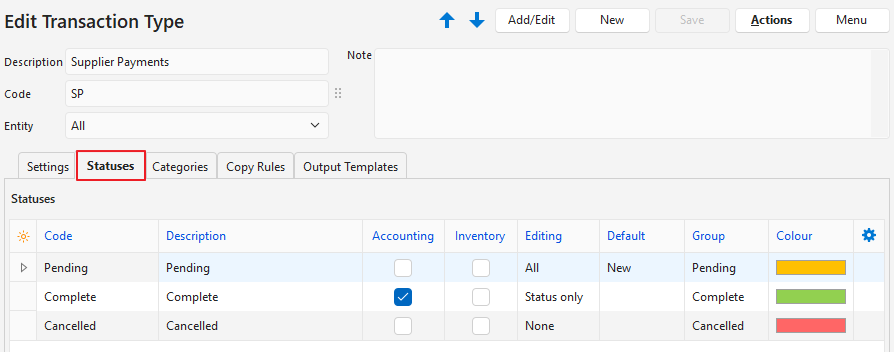
- You may create an unlimited number of Statuses.
- However, there are only four Status Groups (Pending, Active, Complete, and Cancelled).
- The first status should allow editing.
- The final status should ideally not allow editing.
- If the setting Accounting > Enable Accounting is checked, at least one status should have the Accounting column checked.
- If Inventory is used, at least one status should have the Inventory column checked.
- If editing is allowed when the inventory or accounting columns are checked, any accounting or inventory reports should be considered provisional.
Categories (tab)
- Categories are used to sort records.
- The categories you choose should be meaningful to your business.
- Using categories is optional but recommended.
- Categories can be copied from another transaction type. The existing categories are replaced by the copied categories.
No Categories.
Copy Rules (tab)
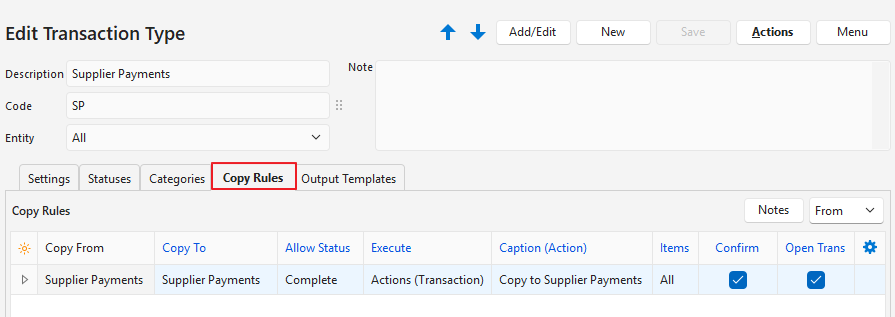
- Copy Rules determine the circumstances under which transactions may be copied.
- Although there are two transactions involved in the copy, you only need to create one copy rule.
- User access must be set for each copy rule.
- You can automate copying transactions by selecting a Trigger status.
- Columns that were hidden in the screenshot were left blank or unchecked.
Output Templates (tab)
- Output templates are the forms you need to print, preview or email a transaction (e.g. invoices).
- Default templates are included which will automatically include your company name, logo, and bank details as filled in on the Output tab of a registered Entity.
- You may edit these templates to include or exclude information.
- You may also create your own forms and templates from scratch.
No Templates

