CRM vs ERP
What is CRM?
Customer Relationship Management software (CRM) provides a platform for businesses to track and manage all the ways customers interact with them. CRM software is used in call centres and support teams, as well as to track sales performance management and sales incentives. Because CRM caters for so many aspects of customers’ journeys, CRM systems are often sold and deployed as stand-alone solutions.
CRM software typically supports the following sales business processes:
- New lead qualification.
- Sales cycle automation, such as scheduling calls and demonstrations.
- Sales forecasting and pipeline management.
- New quote generation and order creation.
- Order confirmation and fulfilment.
- Ongoing account management.
- Renewals and repeat orders.
The Benefits of CRM
CRM provides a central storage place for customer data which enables businesses to keep track of all customer information and interactions.
Aside from the great data analytics, product forecasting, intuitive product offerings, and informed business decisions this software facilitates, it also means that every customer-facing team member within the organisation can provide the personalised customer-contact experience that today’s customers expect. This ensures greater customer loyalty, improved revenue, better sales performance, and higher customer service levels.
For support teams, CRM platforms are invaluable, ensuring support tickets are tracked, updated, and responded to in accordance with Service Level Agreements. It is also possible to track trends and problem areas customers face to create focused solutions. Additionally, CRM can help frontline staff quickly identify if a caller is a high-priority customer and route them to the appropriate service tier.
What is ERP?
Enterprise Resource Planning systems (ERP) evolved out of the material requirements planning software (MRP) of the ’80s, which was how manufacturers understood and managed all the resources required to successfully operate a competitive business.
ERP provides a shared database that unifies every part of a company. ERP revolves around a business’s finances, where transactions automatically update financial records, including the general ledger (GL), accounts payable, accounts receivable, payroll and financial reporting. However, ERP also integrates all aspects of the business, such as inventory management, order management, supply chain management, and production management. Modern ERP solutions like QuickEasy BOS also have procurement, distribution, and fulfilment capabilities as well as CRM packed in one unified platform.
The Benefits of ERP
Global Access
The benefits of an ERP system come from having a single repository of data for the entire business. Modern ERP systems, like QuickEasy BOS, support multiple departments, locations, and currencies. Organisations can manage their operations from a central location and database, regardless of how dispersed their operations are. Additionally, with cloud hosting, staff can access core business tools and data to accomplish their daily tasks from any location, without any interruptions or delays.
Up to date Reports
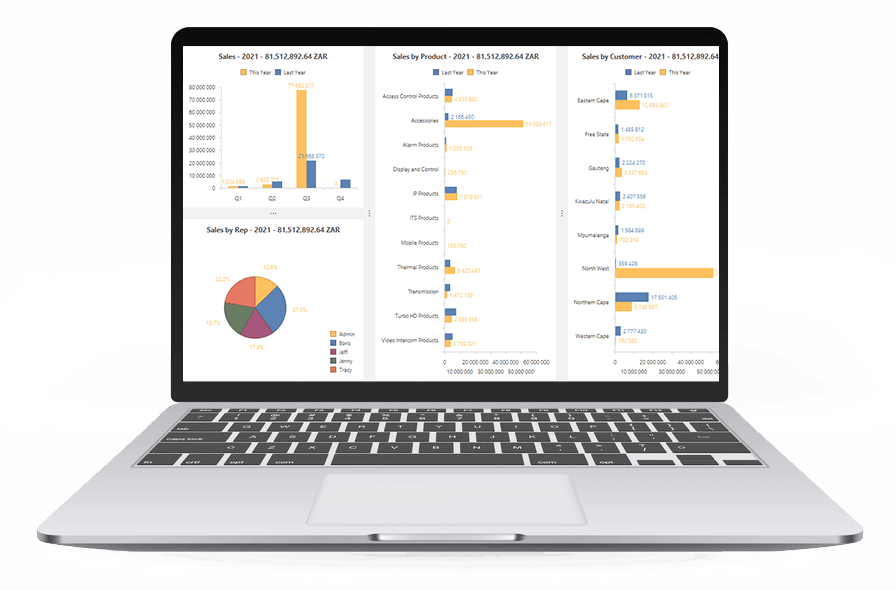
Financial and operational reports are some of the key benefits for business owners and decision-makers. Because an ERP system is a single source of business data, employees and leaders can drill down into historical and real-time reports and unpack insights, trends, and forecasts without the need for an IT or finance team to perform manual analyses for reporting.
Data-driven decisions
Business owners and leaders can make decisions faster, backed by data that is accurate and automated. This advantage could lead to a sustainable, competitive organisation that can take advantage of new growth opportunities and improved operational efficiencies.
Faster financial close
Another clear benefit of ERP systems is a faster financial close. Finance teams typically take stock of all finances coming into – and leaving – the business. They then manually tabulate their findings using spreadsheets or basic accounting software at the end of each month or quarter, which is known as closing the books. This requires arduous manual work, copious amounts of data entry and reaching out to various departments for financial information. A centralised ERP system automates most of these tasks, radically speeding up monthly close times and giving back useful hours to employees for productive work.
Greater control
ERP systems have role-based permissions, security settings, and audit trails which ensure only those with the proper job functions can access sensitive data. This reduces financial risk and streamlines operations.
What is the Difference Between CRM and ERP?
Although the systems overlap, CRM primarily focuses on customer data, while ERP focuses more on finances and operations. The former is commonly referred to as the front office, and the latter as the back office.
Some ERP solutions include a CRM component, but CRM software typically does not include ERP components.
Organisations with complex operations need a full-house, integrated, cloud-based ERP system to manage multiple factories, distribution centres, supply chains, and currencies. They also need a full-fledged CRM system to take care of their sales, support and some of their marketing functions across various markets. What is the solution?
BOS Provides both ERP and CRM Features
With QuickEasy BOS, you get robust ERP that is jam-packed with features, as well as full-house CRM capabilities, installed and supported locally, all at an affordable price.
With BOS’s powerful CRM functionality, you only need to maintain one set of customers, while still easily accessing stock levels, customer transactions, and support tickets, all in one interface.
This means you can do all of these, from one unified platform:
- Automate customer service.
- Generate management reports.
- Manage production planning and distribution.
- Manage sales and customer retentions.
- Monitor KPIs.
- Reduce resource wastage.
- Schedule and follow up on sales leads.
- Store customer data.
- Streamline sales processes.
- Track customer interactions.

