
A CRM solution that integrates with accounting and inventory management

A CRM solution for SMEs should do more than store customer details. A CRM solution that integrates with accounting and inventory management helps you manage the full customer lifecycle. A CRM becomes more valuable when it sits inside the same system as accounting and inventory management.
QuickEasy BOS is built around that idea. This single system gives SMEs CRM as part of a full business operating system, rather than treating CRM as a separate sales tool that has to be connected afterwards.
Skip the queue: Show me QuickEasy BOS
Key takeaways
- A CRM solution that integrates with inventory and accounting helps your team manage the full picture of your customers.
- QuickEasy BOS gives you a fully stacked CRM inside a single business operating system. Customer activity connects to accounting, inventory, quotations, service, production, reporting and the wider operation.
- This means your team can see the customer, the quote, the stock position, the account context and the next action without working across disconnected systems.
- For manufacturers, distributors, printers, packaging companies, signage businesses, engineering firms and service businesses, this is usually more useful than a standalone CRM.
- The real benefit is more clarity and control, and fewer gaps between sales, stock, accounts and service.
Why standalone CRM can be too narrow for operational SMEs
Your customer does not see your business in departments. They do not care whether the answer sits with sales, stores, accounts, service or management. They expect your business to know what was promised, what is available, what has been invoiced, what is outstanding and what happens next.
That is hard to manage when CRM, accounting and inventory sit in separate places.
A standalone CRM usually focuses on the sales side of the relationship. It helps your team manage leads, contacts, notes, tasks, pipelines and follow-ups. That is useful, but it only covers part of the customer journey. In an operational SME, the customer relationship depends on what happens across the business. Sales needs to know what was quoted. Stores needs to know what has been promised. Accounts needs to know whether there is a payment, invoice or statement query. Service needs to know what the customer has reported before. Management needs to see what is open, delayed, won, lost, unresolved or overdue.
If those details sit in separate systems, your CRM does not give the team the full picture. It gives them the customer conversation, but not always the customer truth.
That is the gap QuickEasy BOS is designed to close.
What a CRM solution with accounting and inventory management does
A CRM solution with accounting and inventory management helps your team work from one clear customer view. It shows who the customer is, who the contacts are, what has been discussed, what has been quoted, what is open, what needs follow-up and what may affect the next customer conversation. It connects that customer activity to the most current business information your team needs every day. That includes stock availability, stock movement, pricing, orders, invoices, payments, statements, deposits, credit limits, account queries and service issues.
In QuickEasy BOS, this is handled inside one connected ERP environment. CRM, sales, customer service, accounting, inventory, pricing, reporting and operational activity are part of the same broader system.
How QuickEasy BOS connects CRM and customer service
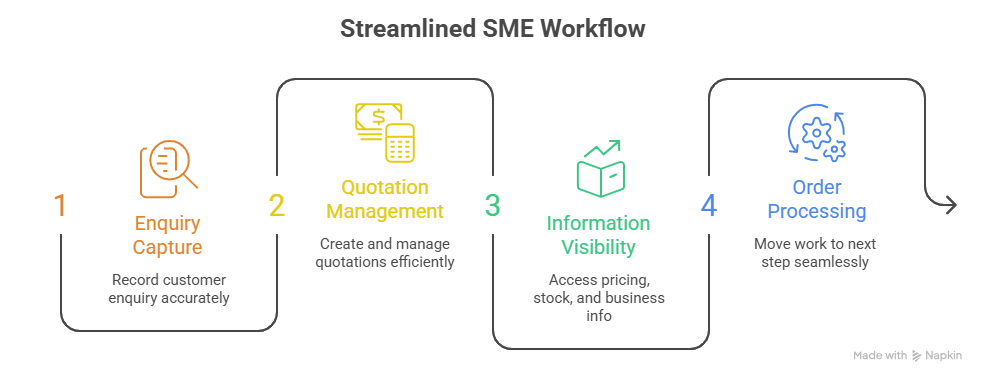
QuickEasy BOS includes sales and customer service functionality to help your team manage customer engagement from enquiry through to account management. That includes centralised enquiry management, where customer enquiries can be captured and tracked across sales, production and accounting. Your team can also see current and past issues per customer, which helps reduce the “who dealt with this last time?” problem.
- For service-related work, BOS supports complaint tracking, job cards, resource allocation, SLA monitoring, service cost and revenue tracking, and customer query management.
- For sales, BOS supports quotations, opportunities, sales reporting and task management for sales teams.
That means customer activity is not left sitting in inboxes, spreadsheets or people’s heads. It can be captured, assigned, followed up and reported on in the same system that supports the rest of the business.
How QuickEasy BOS connects CRM and inventory management
Inventory is often where customer promises become risky. A salesperson may want to say yes. A customer may need an answer quickly. But the business still needs to know what is available, where it is, what it costs and whether anything has changed.
QuickEasy BOS includes materials and inventory functionality that supports stock movements, pricing, multiple item types, multiple locations, different units of measurement, stock checks, approvals and work-in-progress management. This gives customer-facing teams better context when dealing with quotes, orders and customer queries.
Instead of treating inventory as something separate from the customer conversation, BOS helps connect stock activity to the wider customer process. A material, service, outwork item, substrate or assembly needs to be managed with clarity and control. Work-in-progress affects what can be supplied, reserved or ordered. For SMEs that sell products, manufacture, print, package, engineer, distribute or manage jobs, this is a practical CRM advantage. The customer conversation becomes more accurate because it is linked to the stock reality.
How QuickEasy BOS connects CRM and accounting
Accounts are part of customer management. That may sound obvious, but many businesses still treat finance as something that happens after the sale. In practice, account information often affects whether the next sale can happen smoothly.
QuickEasy BOS includes full-suite accounting functionality:
- receivables,
- payables,
- customer statements,
- payment reminders,
- customer deposits,
- overdrawn account controls,
- VAT control,
- multiple currencies,
- multiple entities,
- financial reporting and dashboards.
QuickEasy BOS allows account queries to be captured, assigned and tracked, including queries linked to invoices, payments, credit notes and statements. That is important because finance does not have to work in isolation from customer service, and sales does not have to operate without account context. The customer record becomes more useful because it is connected to the financial activity that affects the relationship.
That is the real value of CRM inside QuickEasy BOS. It does not only help you remember the customer. It helps you manage the entire process that serves the customer.
Who needs this type of CRM solution?
A CRM solution that integrates with accounting and inventory management is especially useful for SMEs where sales and service depend on operational follow-through.
This includes manufacturers, distributors, printers, packaging companies, signage businesses, engineering firms, service teams, contractors and make-to-order businesses.
These businesses usually need more than a sales pipeline. They need customer records that connect to quotes, stock, jobs, invoices, payments, service issues, account queries and reporting. They need fewer gaps between departments. They need fewer promises made without the right information. They need less manual checking before someone can answer a customer properly.
QuickEasy BOS fits this type of business because it is designed as a broader ERP and business operating system, not a stand-alone, isolated CRM tool.
Is QuickEasy BOS a CRM solution?
Yes. QuickEasy BOS includes everything you need in a CRM and customer service functionality. But it is better understood as a full business operating system with CRM built in. If you only need a basic contact list and a simple sales pipeline, BOS may be more system than you need.
But if your SME needs customer management connected to the rest of your business: accounting, inventory, quoting, service, reporting and operational control, then BOS is built for you. Give your team the system they need to manage customer relationships with the business context around them.
Get integrated CRM with accounting and inventory today
QuickEasy BOS gives SMEs a single system for the customer and the work behind the customer.
CRM helps your team manage the relationship. Inventory helps your team understand what can be supplied. Accounting helps your team manage the financial side of the relationship. Customer service helps your team track and resolve issues. Reporting helps management see what is happening.
Together, they give your business a clearer way to serve customers without relying on disconnected tools, repeated admin or internal chasing. If your current CRM solution still leaves your team looking elsewhere for stock, invoice, payment or service information, it may be time to look at QuickEasy BOS.
Book a QuickEasy BOS demo and see how CRM, accounting, inventory management and the rest of your business can work together in one system.
FAQs about CRM solutions with accounting and inventory management
What is a CRM solution?
A CRM solution is software that helps a business manage customer records, contacts, enquiries, sales activity, follow-ups, service issues and customer history. For SMEs, it should make customer information easier to find, manage and act on.
What is a CRM solution with accounting and inventory management?
It is a CRM solution that connects customer activity to financial and stock information. This means your team can manage customers with context around quotes, orders, invoices, payments, stock, pricing, service issues and reporting.
Why should CRM connect to accounting?
CRM should connect to accounting because invoices, payments, deposits, credit notes, statements and account queries often affect customer service and sales. When CRM and accounting work together, sales, finance and service teams can work from a clearer view of the customer.
Why should CRM connect to inventory management?
CRM should connect to inventory management because customers often need accurate answers about availability, pricing, orders, delivery and alternatives. When CRM and inventory work together, the team can respond with better information and fewer internal handovers.
Is QuickEasy BOS a standalone CRM?
No. QuickEasy BOS is a business operating system and ERP platform with CRM included. It is designed for SMEs that need customer management connected to accounting, inventory, sales, service, reporting and operations.
Is an ERP with CRM better than a standalone CRM?
For simple sales teams, a standalone CRM may be enough. For operational SMEs that manage stock, quotes, production, service, accounting and customer queries, an ERP with CRM built in is often a better fit.
Who should consider QuickEasy BOS?
QuickEasy BOS is a strong fit for SMEs that need one system to manage customers, stock, accounts, quoting, service, reporting and operational activity. This includes manufacturers, distributors, printers, packaging companies, signage businesses, engineering firms and service-based SMEs.